
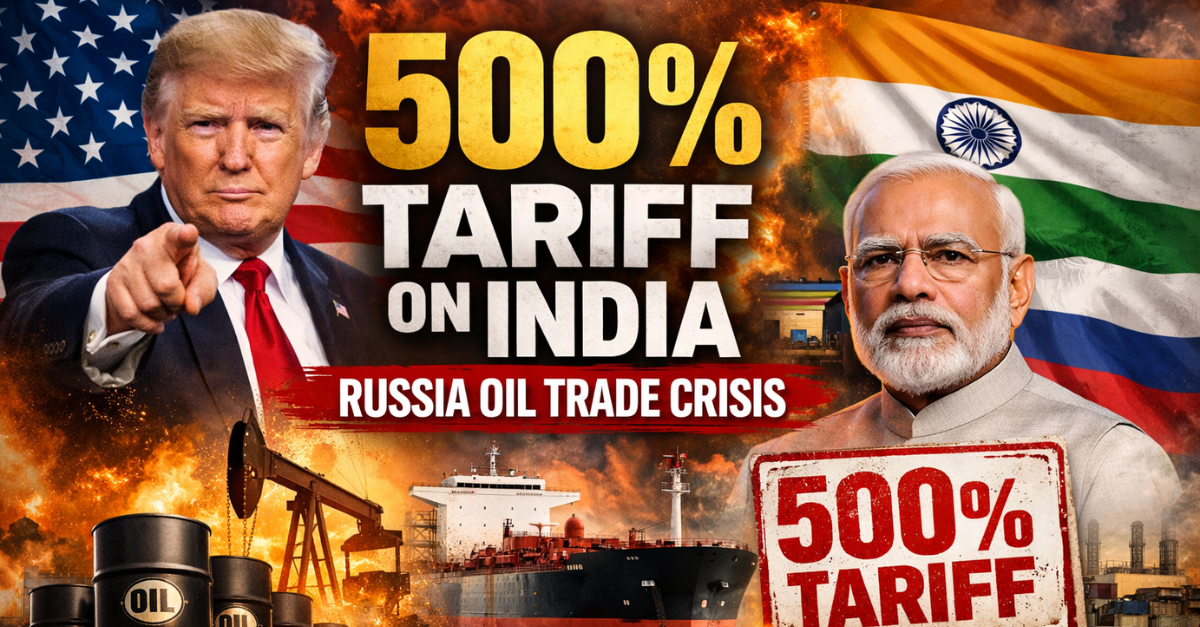
A proposed US legislative bill threatening a 500% tariff on India over its continued trade in Russian oil has emerged as a major flashpoint in global geopolitics. The bill, which aims to penalize countries that maintain significant economic ties with Russia despite Western sanctions, has reportedly received backing from former US President Donald Trump—adding political momentum to a proposal that could dramatically reshape international trade relations.
India, now one of the largest buyers of Russian crude oil, finds itself at the center of this debate. The development raises serious questions about energy security, economic sovereignty, secondary sanctions, and the future of US-India relations at a time when global power dynamics are already under strain.
This article explains, step by step, what the 500% tariff on India proposal is, why it is being considered, and what its real-world consequences could be—not just for India and the US, but for the global economy.
What Is the Proposed 500% Tariff on India Bill?
The proposed legislation seeks to impose punitive tariffs of up to 500% on imports from countries that continue to engage in large-scale trade with Russia, particularly in strategic sectors such as oil, gas, and energy products.
In simple terms, the bill is designed to:
-
Penalize nations that purchase Russian oil
-
Reduce Russia’s energy revenues
-
Enforce Western sanctions indirectly
-
Pressure non-aligned economies into compliance
A tariff of this magnitude is not meant to regulate trade—it is meant to stop trade altogether.
How a 500% Tariff Works in Practice
If Indian goods worth $100 enter the US market:
-
A 500% tariff would add $500 in taxes
-
The final cost becomes $600
-
Making Indian products commercially unviable
This effectively acts as a trade blockade without calling it one.
Why India Is Specifically Targeted
India’s Growing Russia Oil Trade
Since the start of the Ukraine conflict, India has sharply increased its imports of Russian crude oil. Before 2022, Russian oil accounted for less than 2% of India’s total imports. Today, that figure has risen to over 30–35%, making Russia India’s largest crude supplier.
The reasons are economic rather than political:
-
Russian oil is heavily discounted
-
India’s energy demand is massive
-
Domestic inflation control is a priority
-
No UN-mandated ban exists on Russian oil
India purchases crude, refines it domestically, and exports refined products such as diesel and jet fuel to multiple countries—including Western nations.
Donald Trump’s Support and Why It Matters
Donald Trump’s reported backing of the 500% tariff on India bill has elevated the proposal from a congressional idea to a serious political threat.
Trump has long favored:
-
Aggressive tariffs as leverage
-
Economic pressure over diplomacy
-
Trade punishment as a policy tool
His endorsement signals that, if returned to power, such measures could move from proposal to enforcement.
Is This an Example of Secondary Sanctions?
Yes. This bill represents a classic case of secondary sanctions, where a country is punished not for violating sanctions itself, but for trading with a sanctioned nation.
Primary vs Secondary Sanctions
| Type | Target | Example |
|---|---|---|
| Primary sanctions | Russia | Oil export bans |
| Secondary sanctions | India | 500% tariff on exports |
Secondary sanctions are controversial because they:
-
Undermine national sovereignty
-
Force compliance through economic threats
-
Create diplomatic friction even among allies
Potential Economic Impact on India
1. Export Sector at Risk
India exports billions of dollars’ worth of goods to the US, including:
-
Pharmaceuticals
-
Engineering goods
-
Auto components
-
Textiles
-
Industrial machinery
A 500% tariff would:
-
Eliminate price competitiveness
-
Trigger order cancellations
-
Affect employment across export-driven industries
2. Market and Currency Pressure
Such a move could:
-
Increase investor uncertainty
-
Pressure the Indian rupee
-
Cause volatility in equity markets
-
Impact foreign investment inflows
Impact on US-India Strategic Relations
The proposal also risks undermining broader strategic cooperation between India and the US, including:
-
Defense partnerships
-
Indo-Pacific security initiatives
-
Quad alliance coordination
-
Technology and semiconductor collaboration
India is viewed by Washington as a key counterweight to China, making the threat of extreme tariffs strategically contradictory.
Global Energy Market Consequences
If India reduces or stops Russian oil purchases:
-
Global oil supply tightens
-
Prices rise internationally
-
Inflation pressures increase
If India continues buying:
-
Sanction enforcement weakens
-
Trade tensions escalate
-
Alternative financial systems gain momentum
Either outcome carries global consequences.
India’s Possible Response Options
India may respond by:
-
Seeking diplomatic exemptions
-
Expanding non-US export markets
-
Increasing trade settlement in non-dollar currencies
-
Strengthening BRICS and Global South trade ties
Why This Bill Is Being Closely Watched Worldwide
The 500% tariff on India proposal is not just about oil or trade. It represents a broader shift toward economic coercion as a geopolitical tool.
If enforced, it could:
-
Set a precedent for punishing neutral countries
-
Accelerate de-dollarization efforts
-
Fragment global trade systems
Conclusion
The proposed 500% tariff on India over Russia oil trade, backed by Donald Trump, marks a critical moment in global economic diplomacy. While the bill’s future remains uncertain, its implications are already being felt across markets, ministries, and multinational boardrooms.
What happens next will shape not only US-India relations, but the future rules of global trade itself.
FAQs:
1. What is the proposed 500% tariff on India?
The proposed 500% tariff on India is a US legislative measure aimed at imposing extremely high import duties on countries that continue significant trade with Russia, particularly in oil and energy. If enforced, Indian goods entering the US market could face duties five times their original value, effectively making such trade commercially unviable.
2. Why is India being targeted over Russia oil trade?
India has become one of the largest buyers of Russian crude oil since the Ukraine conflict began. While Western nations reduced their imports, India increased purchases due to discounted prices and energy security needs. The bill targets India because of the scale of its Russian oil trade and its indirect impact on Russia’s energy revenues.
3. Has Donald Trump officially supported the 500% tariff bill?
Reports indicate that former US President Donald Trump has backed the proposed 500% tariff bill, aligning with his long-standing stance on using aggressive tariffs as a foreign policy and trade enforcement tool. His support increases the political significance of the bill, especially ahead of future US elections.
4. Is the 500% tariff on India a form of secondary sanctions?
Yes, the proposal is widely viewed as a form of secondary sanctions. Unlike primary sanctions that directly target Russia, secondary sanctions penalize third countries—such as India—for continuing economic engagement with a sanctioned nation.
5. Is India violating any international sanctions by buying Russian oil?
No. India has repeatedly stated that it is not violating any United Nations sanctions. The current restrictions on Russian oil are largely imposed by Western nations, not through binding UN resolutions, allowing India to legally continue its oil imports.

indians are very strong.