
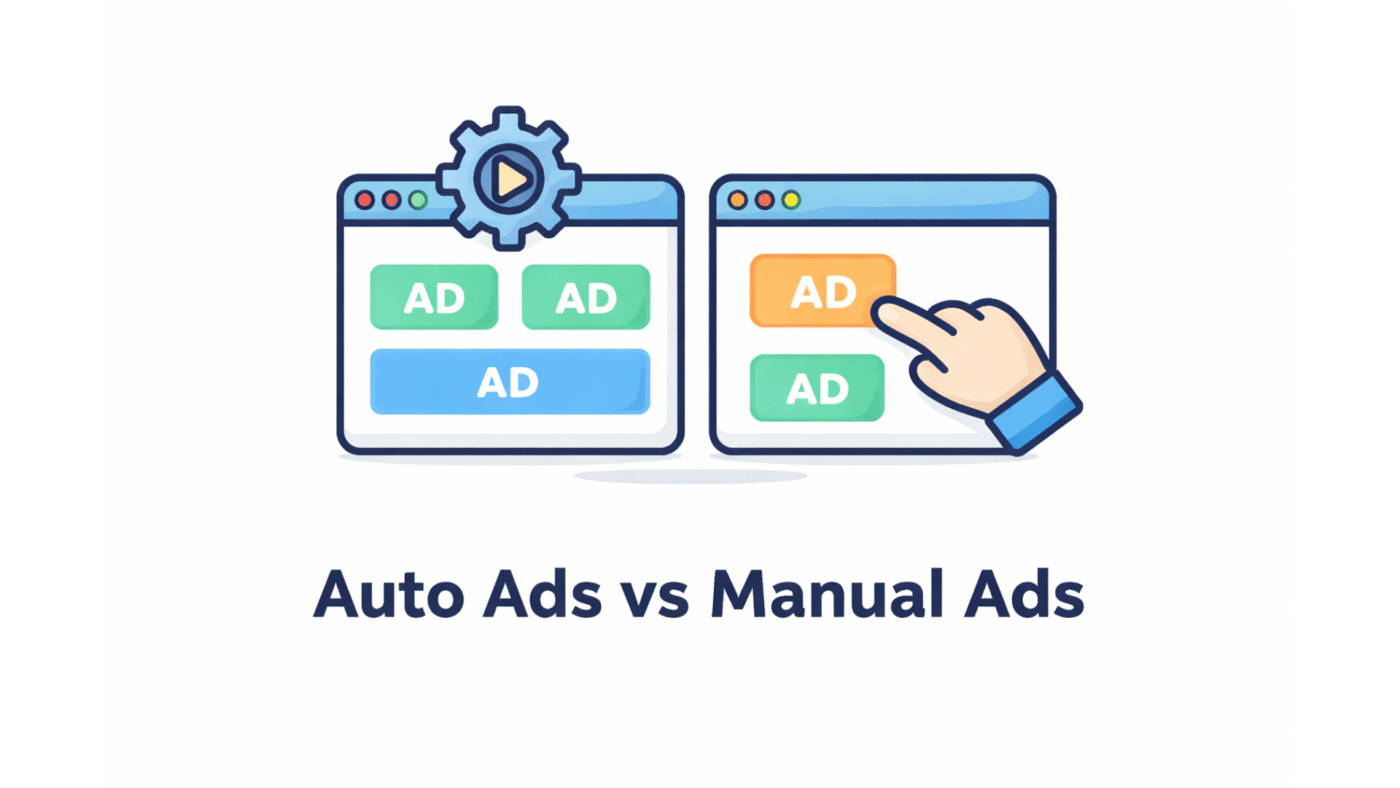
Why Auto Ads vs Manual Ads Is a Revenue Decision, Not a Feature Choice
The debate around Auto Ads vs Manual Ads is one of the most misunderstood topics in website monetization. Many bloggers assume that ad placement is a minor technical detail, but in reality, it directly controls RPM, user engagement, SEO stability, and long-term revenue growth. Two websites with the same traffic can earn 3x–5x different income simply because of how ads are implemented.
Auto Ads promise simplicity and AI optimization, while Manual Ads promise control and precision. However, which one actually makes more money depends on measurable factors such as user behavior, content intent, ad viewability, and layout psychology. This article breaks down Auto Ads vs Manual Ads at a professional level, using real monetization logic and advanced research tools that high-earning publishers rely on.
What Are Auto Ads? (In-Depth Technical Explanation)
Auto Ads are Google AdSense’s AI-driven ad placement system. Instead of placing ad units manually, publishers allow Google’s algorithm to automatically decide where, when, and how many ads should appear on each page. These placements are not fixed; they change dynamically based on device type, screen size, scroll behavior, and historical performance data.
From a technical perspective, Auto Ads scan the DOM structure of a page, detect available white space, and insert ads in areas Google predicts will generate higher impressions and clicks. Over time, the system adjusts placements based on aggregated performance data across millions of websites.
How Auto Ads Generate Revenue
Auto Ads rely heavily on:
-
High ad density
-
Maximum ad fill rate
-
Broad advertiser competition
-
Behavioral prediction rather than intent matching
This means Auto Ads often prioritize volume over precision, which can be both a strength and a weakness depending on the website type.
What Are Manual Ads? (Professional Monetization Perspective)
Manual Ads are ad units placed intentionally by the publisher at specific, fixed positions within the layout. These placements are usually based on user-experience research, scroll-depth analysis, and content intent rather than algorithmic prediction.
Professional publishers use Manual Ads because they allow contextual alignment between content and advertisements. For example, an ad placed immediately after a problem-solving paragraph tends to perform significantly better than one placed randomly by automation.
Why Manual Ads Are Strategically Powerful
Manual Ads allow publishers to:
-
Control ad proximity to high-engagement content
-
Reduce ad blindness
-
Improve ad viewability scores
-
Maintain visual hierarchy
-
Protect SEO and Core Web Vitals
Manual Ads are not about placing fewer ads — they are about placing smarter ads.
Auto Ads vs Manual Ads: Core Differences (Comparison Table)
| Factor | Auto Ads | Manual Ads |
|---|---|---|
| Placement Control | Very Low | Full Control |
| Setup Complexity | Extremely Easy | Requires Skill |
| Revenue Stability | Stable | Variable but Higher |
| RPM Potential | Medium | High |
| User Experience | Often Disrupted | Carefully Optimized |
| SEO Risk | Medium | Low |
| Scalability | Excellent | Requires Effort |
| Best Use Case | Large content sites | High-intent pages |
Auto Ads vs Manual Ads: Which One Actually Makes More Money?
From a purely revenue-focused standpoint, Manual Ads consistently outperform Auto Ads on a per-page basis when implemented correctly. This is because revenue is not driven by impressions alone, but by intent-aligned visibility.
Auto Ads generate revenue by increasing the number of ad impressions, while Manual Ads generate revenue by increasing the value of each impression. Advertisers pay more when ads appear near content that signals strong intent, such as reviews, comparisons, and decision-making content.
Real-World Revenue Pattern
-
Auto Ads increase total impressions by 20–40%
-
Manual Ads increase RPM by 50–200%
-
Manual Ads reduce bounce rate when optimized
-
Auto Ads often increase CLS, harming SEO
This is why professional publishers rarely rely on Auto Ads alone.
10 Professional Research Tools Used to Decide Auto Ads vs Manual Ads
1. Google AdSense Performance Reports
AdSense reports reveal page-level RPM, ad unit performance, and device-based earnings. When comparing Auto Ads vs Manual Ads, publishers analyze which pages produce higher RPM under controlled experiments.
Long-term data often shows that Manual Ads win on high-intent pages, while Auto Ads perform acceptably on informational content.
2. Google Analytics 4 (GA4)
GA4 provides engagement metrics such as:
-
Average engagement time
-
Scroll depth
-
Event interaction
These metrics help publishers identify where users are most attentive, making those areas ideal for manual ad placement.
3. Google Search Console
Search Console is critical for understanding whether ads are affecting SEO. Auto Ads can unintentionally push content downward, impacting rankings. Manual Ads allow publishers to protect above-the-fold content visibility, which is crucial for organic traffic stability.
4. Hotjar Heatmaps
Heatmaps visually show:
-
Scroll behavior
-
Click concentration
-
Attention zones
Manual Ads placed in high-attention zones often outperform Auto Ads by a large margin.
5. Microsoft Clarity
Clarity identifies:
-
Rage clicks
-
Layout shifts
-
Dead zones
Auto Ads frequently cause layout instability, while Manual Ads allow precise CLS control.
6. PageSpeed Insights
Ads directly affect:
-
Largest Contentful Paint (LCP)
-
Cumulative Layout Shift (CLS)
-
Interaction to Next Paint (INP)
Manual Ads can be optimized for lazy loading, while Auto Ads often load unpredictably.
7. AdSense Experiments
AdSense experiments allow A/B testing between Auto Ads and Manual Ads, offering statistically valid revenue comparisons rather than assumptions.
8. Ahrefs / SEMrush
These tools help identify high CPC keywords and transactional intent pages, which are best monetized using Manual Ads rather than automation.
9. Ezoic Analytics
Ezoic provides advanced metrics like:
-
Revenue per visitor
-
Session-based monetization
-
Layout testing
Many publishers use Ezoic to transition from Auto Ads to controlled layouts.
10. Screaming Frog SEO Spider
This tool identifies ad-heavy pages, broken layouts, and over-monetized URLs that could trigger ranking drops.
Best Pages for Auto Ads (Where They Actually Work)
Auto Ads perform best on:
-
News and trending content
-
Viral informational articles
-
Entertainment blogs
-
High-volume, low-intent pages
These pages rely on traffic volume rather than intent.
Best Pages for Manual Ads (Where Real Money Is Made)
Manual Ads dominate on:
-
Product reviews
-
Comparisons
-
Affiliate content
-
Long-form guides
-
Buyer-intent articles
These pages have fewer visitors but far higher revenue per user.
Hybrid Strategy: How Top Publishers Maximize Revenue
Professional publishers do not choose Auto Ads vs Manual Ads — they combine both strategically.
Hybrid Monetization Structure
-
Manual Ads:
-
Homepage
-
Review pages
-
Comparison content
-
-
Auto Ads:
-
Blog posts
-
Category pages
-
Low-priority URLs
-
This approach balances scale, control, and revenue optimization.
Common Monetization Mistakes That Kill Revenue
-
Blindly enabling Auto Ads
-
Ignoring user behavior
-
Overloading mobile pages
-
Not testing placements
-
Prioritizing ad count over quality
Final Verdict: Auto Ads vs Manual Ads
Auto Ads vs Manual Ads is not a beginner vs expert debate — it is a revenue strategy decision.
-
Auto Ads = Convenience and stability
-
Manual Ads = Control and higher earnings
-
Hybrid = Maximum long-term revenue
Manual Ads make more money. Hybrid strategies make the most money.
Conclusion: Monetization Is a Skill, Not a Setting
Real ad revenue does not come from turning on a feature — it comes from understanding user psychology, content intent, and data-driven optimization. Publishers who master Auto Ads vs Manual Ads gain a competitive advantage that compounds over time.
Read More: How to Secure Your Android Phone Without Installing Any App

This is a very well explained article. I was confused between Auto Ads and Manual Ads for a long time, but this comparison made everything clear. The hybrid strategy you explained makes the most sense. Thanks for sharing such practical insights.
thank you
Great breakdown of Auto Ads vs Manual Ads. I personally noticed better RPM with manual placements, but auto ads helped on low traffic pages. This article helped me understand why that happens. Really informative post.
thank you
Very useful content, especially for beginners like me. The explanation is simple and easy to understand. Now I know when to use Auto Ads and when Manual Ads work better. Keep publishing such helpful articles.
thank you